Apr 13, 2010

Korea FDC on "Old & Historic Trees of Korea (2nd Series)"


First Day Cover
首日封
Sobrescrito de 1.º Dia

South Korea

Old & Historic Trees of Korea (2nd Series)

Date of Issue : 5 April 2010

As the second installment of the “Old & Historic Trees of Korea” series, four old and historic trees that have achieved their beauty over a long period of time are introduced.

Old Buddha's Plum at Baegyangsa Temple in Jangseong (Natural Monuments No. 486)
Every year when March arrives at Baegyangsa Temple located at Jangseong, Jeollanam-do province, plum tree blossom splendidly, with their delicate scent swirling around the entire temple. Among the plum trees that have been raised in the front yard of Baegyangsa Temple since 1700, a red plum tree was transplanted with the relocation of the temple to its current location in 1863. This is the tree that came to be called Gobulmae: it came to be called by its new name, Gobulmae, as Gobulchongnim, the Old Buddha's Monastery, was formed at Baegyangsa Temple to pay tribute to the original teachings of Sakyamuni

Pine tree at Samsong-ri, Goesan (Natural Monuments No. 290)
The pine tree at Samsong-ri, Goesan, also called Yongsong (dragon pine tree) since it resembles a wriggling dragon, is really beautiful in the way its trunk, split into two, twists together. It is also called “Wang-sonamu” (king pine tree) since it is 600 years old and as tall as 13.5 meters - tallest in the forest. People offer ancestral rites to this tree every January, praying for good harvest and peace for the coming year.

Thunbergii camphor, at Samsan-ri, Jangheung (Natural Monuments No. 481)
At Samsan-ri, Jangheung, three Thunbergii camphor mingle together as if they were just one tree. They show such a thick, lush green all year around that they are reminiscent of a little forest on its own. Taking unique and beautiful forms, they are 11 meters tall and about 400 years old. According to related legend, they were planted by the ancestors of the Gyeongju Yi clan in approximately 1580 when they settled in this area. Being the village’s guardian tree that has shared the same history as the village, the trees are highly valued in terms of folklore.

Pair of Chinese junipers of Songgwangsa Temple (Natural Monuments No. 88)
Pair of Chinese junipers at Songgwang Temple, Suncheon assume an amazing shape, as the two trees stand side by side with their trunks twisted together, looking as if the dragons are wriggling to prepare for an ascent to the sky. According to related legend, a Bojo national priest and a Damdang national priest during the Goryeo Dynasty placed their canes made of Chinese juniper, which they used on their travels back to Korea from China, and the canes turned into these marvelous pair of trees. They are about 800 years old and 12 meters tall.

Nice stamp design as usual. This time, my friend affixed 3 definitive stamps on the back of the cover, with nice and clear datestamp cancellation. It is the first time I ever seen the new 1000 Won definitive stamp. It was introduced on 17 Nov 2009, featuring “Cheongjasajayugaehyangno” (Celadon incense burner with lion-shaped lid). To prevent counterfeit or forgery, this 1000 Won definitive stamp, has adopted both printing in optically variable ink as well as minute letters. The letters “한국우정KOREA POST” are printed in optically variable ink on the right side of the background, and these letters become visible when the stamp is tilted. And at the bottom part of the incense burner, “한국우정KOREA POST,” is inserted in minute letters.

Apr 12, 2010

China FDC on "Qingming (Pure Brightness) Festival"


First Day Cover
首日封
Sobrescrito de 1.º Dia

China


Qingming (Pure Brightness) Festival

Date of Issue : 5 April 2010

(The 1.20 Yuan stamps from left to right)
3-1 : Ancestor Worship
3-2 : Spring Outing
3-3 : Planting Willows

Qingming (Pure Brightness) Festival, also known as Tomb Sweeping Day, is a traditional festival featuring folk customs, named after one of the 24 solar terms on traditional Chinese calendar. It was early documented in an astronomical book of the Western Han (206B.C. - A.D.24), and become a popular festival during the Tang (618 - 907) and Song (960 - 1279) dynasties, falling in the third lunar month, or around 5 April of the Gregorian calendar. Traditional customs for the festival, such as sweeping tombs, going out for a walk in the countryside, and planting trees, have remained prevalent till today.

In 2006, the festival was included on China's National Intangible Cultural Heritage List.

Apr 2, 2010

Korea FDC on "Centennial of the Death of Martyr Ahn Jung-geun"


First Day Cover
首日封
Sobrescrito de 1.º Dia

South Korea

Centennial of the Death of Martyr Ahn Jung-geun

Date of Issue : 26 March 2010

Ahn Jung-geun was born in 1879 in Haeju, Hwanghae-do province. Influenced by his father, an enlightenment reformer, he formed a grand vision at an early age of Korea recovering its national sovereignty and achieving an era of enlightenment by nurturing national vigor and devoted himself to such educational movements as establishing schools. After realizing that it would be impossible to nurture Korea’s national power under Japanese imperialist rule which willfully suppressed the education of the Korean people, he went abroad to raise an army to fight in the cause of justice of reclaiming national sovereignty through armed resistance.

In March 1909, he and his 11 like-minded comrades formed a finger-cutting fraternity to display their commitment to the fatherland’s independence by cutting off their left hand ring-fingers and writing, with the resulting blood, the letters “Daehandongnip” (independence of Korea from Japanese colonial ruling) on the Taegeukgi (the national flag of Korea).

In October that year, he plotted an attack upon hearing that Ito Hirobumi, the chief ringleader in the Japanese deprivation of Korea’s sovereign independence, would visit Harbin. In October 26, 1909, he aimed his gun at Ito Hirobumi, as he stepped into the Harbin railway platform. This was the moment when a historical, heroic deed occurred.

After his arrest, he never lost his fortitude up to his very last day when his death sentence was carried out.

In commemoration of the centennial of the death of patriot Ahn Jung-geun, a commemorative stamp is issued, featuring his thumbprint and the letters written on the Taegeukgi with his blood. In the stamp, the will he left is expressed as minute letters on the image of his ring-finger, while “the cherished intentions of Ahn Eung-chil (patriot Ahn’s childhood name)” written in prison, are also written on the image of the Taegeukgi.

A nice stamp issue as a remembrance to a martyr of Korea.

Apr 1, 2010

Estonia FDC on "St Catherine's of Pärnu"


First Day Cover
首日封
Sobrescrito de 1.º Dia

Estonia

St Catherine's of Pärnu

Date of Issue : 23 March 2010

In 1760 Catherine II of Russia decided to build an Orthodox church in Pärnu. She trusted the work to Pyotr Yegorov, an architect of Chuvash descent, for whom it was the first independent project. Building work started in 1764 and St Catherine’s of Pärnu, one of the most stylish and sumptuous Baroque churches in Estonia was inaugurated in 1768. It has Greek cross ground plan with an elegant belfry and several other slender towers. The faade has a rich repertory of elements of decor – cornices, frontals etc. The church is an outstanding building in Pärnu’s historical centre.

A very nice FDC issued on a very special date of 23 March, my birthday !

Mar 31, 2010

Taiwan FDC on "Wild Mushrooms of Taiwan Postage Stamps (I)"


First Day Cover
首日封
Sobrescrito de 1.º Dia

Taiwan

Wild Mushrooms of Taiwan Postage Stamps (I)

Date of Issue : 25 March 2010

NT$5 stamp : Dictyophora multicolor
A stinkhorn mushroom of mid-to-large size. The exterior of the bell-shaped cap (pileus) atop the stem is covered with a foul-smelling spore-containing substance called gleba, which attracts insects to help spread the spores. There is a bright yellow veil-like skirt (membrane) under the cap. The mushroom can often be seen in bamboo groves or broad-leaved forests in low-altitude areas. It is not edible.

NT$5 stamp : Pleurotus salmoneostramineus
The cap of this gilled mushroom resembles a sea-shell. It has a fuzzy outer surface. When fresh, its color is pink to salmon. The stem is short and has a sideways-growth. It is often found growing in clumps on decaying wood in broad-leaved forests in low-altitude areas. Though edible, its texture is coarse

NT$12 stamp : Pseudocolus fusiformis
At first, the fruiting body of this mushroom resembles a white ball, and then it cracks open and a stem arises with three orange finger-like arms at maturity. The inside surface of the arms is covered with a stinky spore-containing substance to attract insects to help spread the spores. It can often be seen growing on the roadside at the edge of broad-leaved forests in low altitude area. It is not edible.

NT$12 stamp : Coprinus disseminatus
The cap of its fruiting body is shaped like a cone or bell and the edge is deeply grooved. Its fresh is thin. The stem is slender and fragile. It is often found growing in clusters on decaying wood in low-altitude areas. It is not edible.

Very nice stamp issue. I especially like the souvenir sheet.

Mar 30, 2010

Monaco Cover


Cover

Sobrescrito

Monaco

On the cover above, there are two old triangle shaped stamps and a very nice stamp of "80th Anniversary of Grace Kelly's Birth" issued on 4 Dec 2009. Grace Patricia Kelly was born on 12 Nov 1929 in Philadelphia, Pennsylvania. She attended the American Academy of Dramatic Arts in New York and had her first leading role in High Noon in 1952. She then became Alfred Hitchcock’s favourite actress, starring in three of his films: Dial M for Murder, Rear Window and To Catch a Thief. Grace Kelly won an Oscar for Best Actress in 1955 for her performance in A Country Girl. In 1956, when she married Prince Rainier III, she became Princess of Monaco and put a stop to her acting career.

An unexpected surprise from my friend in France. This is my first cover and stamps from Monaco. The postal delivery was really fast, just took 6 days. Nice stamps and clear cancellation. Everything is just perfect. Thank You very much to my friend!

Mar 29, 2010

Sri Lanka Postcard - Kandy Perahera


Postcard
明信片
Bilhete Postal

Sri Lanka

A very beautiful postcard of Kandy Perahera from Sri Lanka. My friend was so kind to sent this postcard on 23 March, my birthday. This time, there is also a nice airmail label affixed on the card. Thank You very much!

Mar 28, 2010

Hong Kong Postage Prepaid Postcard


Postcard
明信片
Bilhete Postal

Hong Kong

The card shown above is a Hong Kong Year of Tiger Postage Prepaid card issued on 6 Feb 2010, with the autograph of Mr Bon Kwan, the stamp designer. This card was sent on 23 March, my birthday. Besides the pictorial postmark of Kwun Tong. You can also find an unclear AMC double ring datestamp cancellation on the front of the card.

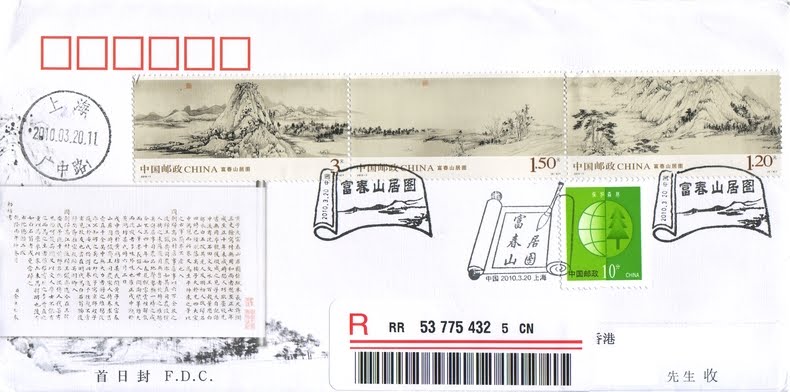
China FDC on "Dwelling in the Fuchun Mountains"


First Day Cover
首日封
Sobrescrito de 1.º Dia

China


Dwelling in the Fuchun Mountains (富春山居圖)

Date of Issue : 20 March 2010

The horizontal ink-and-wash scroll painting "Dwelling in the Fuchun Mountains (富春山居圖)" is the magnum opus of renowned Yuan Dynasty painter Huang Gongwang (黃公望, 1269-1354). A native of Changshu, Jiangsu Province, Huang was reversed as the first of the Four Great Masters of the Yuan, the other three being Wu Zhen, Ni Zan and Wang Meng. Most of the paintings were devoted to the beautiful landscapes in the regions south of the lower reaches of the Yangtze River, including Fuyang, Zhejiang Province, where he spent the last years of his life. This painting, with a precise layout, vivid strokes, and a profound meaning, depicted the enchanting scenery along both banks of the Fuchun River, and exerted a deep influence upon Chinese landscape paintings in the following generations. Unfortunately, the painting was burnt into two pieces in the early Qing Dynasty (1644-1911). Today, one piece is kept in the Zhejiang Provincial Museum in Huangzhou, while the other is perserved in the Palace Museum in Taipei.

Mar 26, 2010

Slovakia FDC on "Matthew Czak of Trenčín (Matúš Čák Trenčiansky) (1260 – 1321)"


First Day Cover
首日封
Sobrescrito de 1.º Dia

Slovakia

Matthew Czak of Trenčín (Matúš Čák Trenčiansky) (1260 – 1321)

Date of Issue : 12 Mar 2010

The uncrowned king of Upper Hungary (today’s Slovakia) Matthew Czak was born in about 1260. His father Peter and his uncle Matthews held the office of Marshall Palatine during the reign of the incompetent king Ladislav IV. Cuman, and as a result, they were obtaining large properties in the south-western Slovakia. The young Matthew Czak became their sole heir.

In the Přemysl-Anjou fight for a succession he first supported the Czech crown prince Wenceslas, who in 1302 bestowed him with counties Nitra and Trenčín. Toward the end of the following year he changed sides and became a supporter of Charles Robert, but despite his several promises he never recognized him as his king in public. In spite of this, Charles Robert appointed him a palatine in 1309 and at the beginning of the following year also treasurer (the person in charge of royal income). As Matthew Czak was visibly misusing these positions for his own benefit, the king deposed him from his office. In these times Matthew already acted as an independent ruler, and kept the same dignitaries as the king at his court in Trenčín. The bases of his power became a whole system of stone castles. He owned more than 60 stone castles, of which 50 in the area of today’s Slovakia. The status of Matthew was undermined to a certain extent by the loss of a part of his army in the Battle of Rozhanovce in 1312. However, in 1315 he managed to beat back the attack of the Czech king Jan Luxemburg on the castle of Holíč.

He died naturally on March 18th, 1321 in Trenčín castle. King’s army took possession of all his castles in stages. His contemporaries called his possessions „Terra Matthei“ (The Land of Matthew). Its territorial scope corresponds almost precisely with the territory belonging to Pribina’s Principate in Nitra.

Mar 25, 2010

Aruba Postcard - Oranjestad Royal Plaza


Postcard
明信片
Bilhete Postal

Aruba

Here is a nice view card of the Oranjestad Royal Plaza in Aruba. Aruba is one of the three countries that form the Kingdom of the Netherlands, together with the Netherlands and the Netherlands Antilles.

Mar 24, 2010

Moldova Postcard - The Academy of Sciences


Postcard
明信片
Bilhete Postal

Moldova

A nice view card of the Academy of Sciences of Moldova. My friend was so kind to affix 3 very beautiful stamps on the card. Thank You very much !

Mar 19, 2010

Estonia FDC on "2010 World EXPO"


First Day Cover
首日封
Sobrescrito de 1.º Dia

Estonia

2010 World EXPO

Date of Issue : 11 March 2010

The first world fair, The Great Exhibition of 1851, was held in Hyde Park London under the auspices of Prince Albert. The Crystal Palace, in which the whole world displayed its achievements, was built for the fair. Since 1928 Bureau International des Expositions (BIE), headquartered in Paris, coordinates holding of the fairs. By today 156 countries have acceded to BIE.

This year’s EXPO will take place from May 1 to October 31 in Shanghai in the People’s Republic of China. Estonia has so far taken part in ten world fairs. The stamp features the Estonian pavilion in Shanghai.

This is my first World Expo 2010 FDC outside China. Very nice !

Mar 16, 2010

China Postage Prepaid Postcard - Guangdong Maritime Silk Road Museum


Postcard
明信片
Bilhete Postal

China


During my Chinese new year holiday this year, I have spent some days at Hailing Island of Yangjiang city, Guangdong. One of the tourist attractions there is the Maritime Silk Road Museum, which contain an 800-year-old wrecked merchantman called 'South Sea No. 1' ('Nanhai 1') , that traded along the Marine Silk Route during the Southern Song Dynasty (1127 - 1279).

The two postage prepaid postcards shown above were sent from there. They are actually 2 different types of admission tickets of the museum.

Mar 15, 2010

Estonia FDC on "Lesser Butterfly Orchid"


First Day Cover
首日封
Sobrescrito de 1.º Dia

Estonia

Lesser Butterfly Orchid

Date of Issue : 19 February 2010

The lesser butterfly orchid (Platanthera bifolia) is one of the most common and also one the most favourite Estonian orchids. It can be found almost anywhere in the country but slightly more frequently in wetland meadows and sparse woods in Western Estonia. It has been given nearly one hundred popular names, of which ööviiul (night violin) is perhaps the most widespread. Apart from the cluster of its beautiful flowers it also has a two strong and prominent leaves united at the bottom that serve as a distinguishing feature from a related species, Platanthera chloranta. With the arrival of night the lesser butterfly orchid starts sending out a particularly strong scent that pervades the whole meadow or forest floor with it sweet and sometimes even rank odour. The smell attracts large numbers of insects to feed on the nectar in its long spur of up to three and half centimetres, but only butterflies with a long proboscis can really feast on it.

Mar 14, 2010

China FDC on "Centennial Anniversary of International Women's Day"


First Day Cover
首日封
Sobrescrito de 1.º Dia

China


Centennial Anniversary of International Women's Day

Date of Issue : 8 March 2010

March 8, 2010 marks the centennial anniversary of International Woman's Day. On March 8, 1909, Chicago woman workers marched in strike, demanding for better conditions. The next year, at the Second International Conference of Working Woman, Clara Zetkin, leader of the Woman's Office for the Social Democratic Party in Germany, proposed that every year in every country there should be a celebration of International Woman's Day on March 8, as was unanimously approved. In December 1949, Chinese central government designated March 8 as Woman's Day.

Mar 12, 2010

Sri Lanka Postcard - Frescos in Sigiriya


Postcard
明信片
Bilhete Postal

Sri Lanka

Very beautiful postcard from Sri Lanka with clear cancellation. I very much like the long and nice stamps affixed on the card.

Slovakia FDC on "Easter 2010: Initial with Suffering Christ from the Bratislava Mass-book"


First Day Cover
首日封
Sobrescrito de 1.º Dia

Slovakia

Easter 2010: Initial with Suffering Christ from the Bratislava Mass-book

Date of Issue : 26 Feb 2010

The manuscript of the Bratislava Mass-book VI had 310 parchment sheets (films) based on the description of the priest Nándor Knauz already in the 2nd half of the 19th century. In the City Museum in Bratislava or in the Archive of the City of Bratislava, only fragments with several figural miniatures (e.g. the figure of King David) or initials with side decoration have been preserved. Only recently, in the Szépművészeti museum in Budapest, another part of this Code was identified – a whole-page miniature of so-called Canonical Crucifixion. In 1870 Knauz published also one record from today missing sheet, based on which the manuscript was completed by Bratislava priest Michael from Trnava in 1403.

The initial T- e igitur on sheet 7r emphasizes the beginning of the most important liturgical part of the mass-book – canon. The topic of the framed miniature is a half-figure of the Suffering Christ with crossed hands at the belly standing in the grave – so-called Imago pietatis. The bleeding wounds are emphasized in the hands and in the waist. Three nails, knout and whip, but also the sepulchre of the tomb extend the initial contents by the motifs of the tools of Christ´s Martyrdom– Arma Christi. While out of letter T there is only blue upper arm visible behind its figure (at the same time like indication of a cross), the rest of the heading is carefully painted with golden letters upright next to the miniature.

Another decoration consists of colourful, thin-line outlined acanthus leaves on the inner edge of the page. According to the shape of this decor, as well as with the comparison of the above-mentioned miniature from Budapest we may come to the conclusion that the illuminator of the mass-book was inspired by the Prague manuscripts of the King Wenceslaus IV, mainly its Bible (illuminator Frána, around 1390). The impact of the Czech art of that time was really important in the entire Central Europe, and also in the library of the Bratislava Canonry we may find many such focused illuminations. On the other hand, its relatively abundant library and the vicinity of Vienna illuminator´s studios suggest also the possibility of the operation of separate painting shops directly in Bratislava.

My friend was so nice to affix both the Easter stamp issued in 2009 and 2010. The Easter stamp issued last year was colourful, while the 2010 Easter stamp adopt a classical design. I like both the Easter stamp of 2009 and 2010.

Mar 10, 2010

Cuba Postcard - La Fuerza Castle


Postcard
明信片
Bilhete Postal

Cuba

A beautiful postcards of La Fuerza Castle, Cuba. Its nice that my friend affixed a 60th founding of China stamp from Cuba. The stamp was designed by José Antonio Medina from Chinese platanized work of the prominent artist Flora Fong, and part of his personal exhibition of China to the Caribbean.

Mar 9, 2010

Israel FDC on "Fifty years of settling the Arava"


First Day Cover
首日封
Sobrescrito de 1.º Dia

Israel

Fifty years of settling the Arava

Date of Issue : 27 January 2010

The Central Arava and Eilot Regional Councils stretch over 2,800 square kilometers, which is roughly 17% of the area of Israel. The two regional councils house about 7,000 residents, living in 20 residential communities, kibbutzim, agricultural moshav communities and rural communities. The main sources of livelihood among the area’s residents are agriculture, tourism, services and industry.

Local agricultural crops include dates, peppers and various field crops as well as the dairy industry, with the Yotvata Dairy at its core. The Arava farmers produce some 60% of Israel's vegetable exports, 10% of the country’s cut flowers and some 90% of the ornamental fish exported from Israel. The area is home to the Ardom date packing plant, agricultural research & development centers, a telecommunications company and more.

Several archeological sites are under development, including the Ovda Valley and ancient agricultural sites dating from the 5th century B.C.E.

The stamp marking 50 years of Arava settlement symbolizes and commemorates the determination of Arava settlers to turn the desert valley into flourishing, attractive settlements for new residents, visionary entrepreneurs and tourists.

Mar 8, 2010

Finland Postcard - Helsinki Olympic Stadium


Postcard
明信片
Bilhete Postal

Finland

A really nice card showing the Olympic Stadium in Helsinki.

Mar 6, 2010

USA Postcard - Cleveland


Postcard
明信片
Bilhete Postal

USA

A nice Cleveland postcard. It is not easy to have such a clear cancellation for USA postcard.

Mar 5, 2010

Algeria FDC on "Homage to the Victims of the French Nuclear Tests in Algeria"


First Day Cover
首日封
Sobrescrito de 1.º Dia

Algeria

Homage to the Victims of the French Nuclear Tests in Algeria

Date of Issue : 10 Feb 2010

(The information below is taken from the website : http://timbredujura.blogspot.com/2010/02/essais-nucleaires-francais-et-forts-en.html)

50 years to the day after the first French air nuclear test that took place in the middle of the Algerian Sahara (near the town of Reggane), the Algerian Post has issued a stamp (15 dinars) to pay tribute to the victims of these tests.

Nearly 40,000 people living in this Sahara region have suffered the effects of radioactive contamination after the four French nuclear tests conducted at Reggane from 1960 to 1961 and the 13 underground tests that took place in the Hoggar region from 1961 to 1966...

Mar 4, 2010

Estonia FDC on "Definitive Stamp. Post Horn"


First Day Cover
首日封
Sobrescrito de 1.º Dia

Estonia

Definitive Stamp. Post Horn

Date of Issue : 04 February 2010

The first definitive stamps after the restoration of Estonian independence, featuring the coat of arms of the country (three leopards), were issued on 1 October 1991.

All the definitive stamps issued since September 2004 are self-adhesive. A new series of post horn definitive stamps was launched in 2008. The first such stamp was issued on sale in all Estonia’s post offices from 10 January 2008. The stamp shown on the FDC above is the fifth in the series.