
Postcard
明信片
Bilhete Postal
 Mauritus
A really very very beautiful postcard showing the Rochester Falls & Gris Gris, on the southern side of Mauritus. I just wish I was there. The stamps on the card are also nice too. Thank You very much !
Mauritus
 Slovakia
 Belgium
 South Korea
 Date of Issue : 5 April 2010
As the second installment of the “Old & Historic Trees of Korea” series, four old and historic trees that have achieved their beauty over a long period of time are introduced.
Old Buddha's Plum at Baegyangsa Temple in Jangseong (Natural Monuments No. 486)
Every year when March arrives at Baegyangsa Temple located at Jangseong, Jeollanam-do province, plum tree blossom splendidly, with their delicate scent swirling around the entire temple. Among the plum trees that have been raised in the front yard of Baegyangsa Temple since 1700, a red plum tree was transplanted with the relocation of the temple to its current location in 1863. This is the tree that came to be called Gobulmae: it came to be called by its new name, Gobulmae, as Gobulchongnim, the Old Buddha's Monastery, was formed at Baegyangsa Temple to pay tribute to the original teachings of Sakyamuni
Pine tree at Samsong-ri, Goesan (Natural Monuments No. 290)
The pine tree at Samsong-ri, Goesan, also called Yongsong (dragon pine tree) since it resembles a wriggling dragon, is really beautiful in the way its trunk, split into two, twists together. It is also called “Wang-sonamu” (king pine tree) since it is 600 years old and as tall as 13.5 meters - tallest in the forest. People offer ancestral rites to this tree every January, praying for good harvest and peace for the coming year.
Thunbergii camphor, at Samsan-ri, Jangheung (Natural Monuments No. 481)
At Samsan-ri, Jangheung, three Thunbergii camphor mingle together as if they were just one tree. They show such a thick, lush green all year around that they are reminiscent of a little forest on its own. Taking unique and beautiful forms, they are 11 meters tall and about 400 years old. According to related legend, they were planted by the ancestors of the Gyeongju Yi clan in approximately 1580 when they settled in this area. Being the village’s guardian tree that has shared the same history as the village, the trees are highly valued in terms of folklore.
Pair of Chinese junipers of Songgwangsa Temple (Natural Monuments No. 88)
Pair of Chinese junipers at Songgwang Temple, Suncheon assume an amazing shape, as the two trees stand side by side with their trunks twisted together, looking as if the dragons are wriggling to prepare for an ascent to the sky. According to related legend, a Bojo national priest and a Damdang national priest during the Goryeo Dynasty placed their canes made of Chinese juniper, which they used on their travels back to Korea from China, and the canes turned into these marvelous pair of trees. They are about 800 years old and 12 meters tall.
Nice stamp design as usual. This time, my friend affixed 3 definitive stamps on the back of the cover, with nice and clear datestamp cancellation. It is the first time I ever seen the new 1000 Won definitive stamp. It was introduced on 17 Nov 2009, featuring “Cheongjasajayugaehyangno” (Celadon incense burner with lion-shaped lid). To prevent counterfeit or forgery, this 1000 Won definitive stamp, has adopted both printing in optically variable ink as well as minute letters. The letters “한국우정KOREA POST” are printed in optically variable ink on the right side of the background, and these letters become visible when the stamp is tilted. And at the bottom part of the incense burner, “한국우정KOREA POST,” is inserted in minute letters.

 China
China South Korea
 Date of Issue : 26 March 2010
Ahn Jung-geun was born in 1879 in Haeju, Hwanghae-do province. Influenced by his father, an enlightenment reformer, he formed a grand vision at an early age of Korea recovering its national sovereignty and achieving an era of enlightenment by nurturing national vigor and devoted himself to such educational movements as establishing schools. After realizing that it would be impossible to nurture Korea’s national power under Japanese imperialist rule which willfully suppressed the education of the Korean people, he went abroad to raise an army to fight in the cause of justice of reclaiming national sovereignty through armed resistance.
In March 1909, he and his 11 like-minded comrades formed a finger-cutting fraternity to display their commitment to the fatherland’s independence by cutting off their left hand ring-fingers and writing, with the resulting blood, the letters “Daehandongnip” (independence of Korea from Japanese colonial ruling) on the Taegeukgi (the national flag of Korea).
In October that year, he plotted an attack upon hearing that Ito Hirobumi, the chief ringleader in the Japanese deprivation of Korea’s sovereign independence, would visit Harbin. In October 26, 1909, he aimed his gun at Ito Hirobumi, as he stepped into the Harbin railway platform. This was the moment when a historical, heroic deed occurred.
After his arrest, he never lost his fortitude up to his very last day when his death sentence was carried out.
In commemoration of the centennial of the death of patriot Ahn Jung-geun, a commemorative stamp is issued, featuring his thumbprint and the letters written on the Taegeukgi with his blood. In the stamp, the will he left is expressed as minute letters on the image of his ring-finger, while “the cherished intentions of Ahn Eung-chil (patriot Ahn’s childhood name)” written in prison, are also written on the image of the Taegeukgi.
A nice stamp issue as a remembrance to a martyr of Korea.

 Estonia
Date of Issue : 23 March 2010
In 1760 Catherine II of Russia decided to build an Orthodox church in Pärnu. She trusted the work to Pyotr Yegorov, an architect of Chuvash descent, for whom it was the first independent project. Building work started in 1764 and St Catherine’s of Pärnu, one of the most stylish and sumptuous Baroque churches in Estonia was inaugurated in 1768. It has Greek cross ground plan with an elegant belfry and several other slender towers. The faade has a rich repertory of elements of decor – cornices, frontals etc. The church is an outstanding building in Pärnu’s historical centre.
A very nice FDC issued on a very special date of 23 March, my birthday !


 Taiwan
 Monaco
 Sri Lanka
 Hong Kong
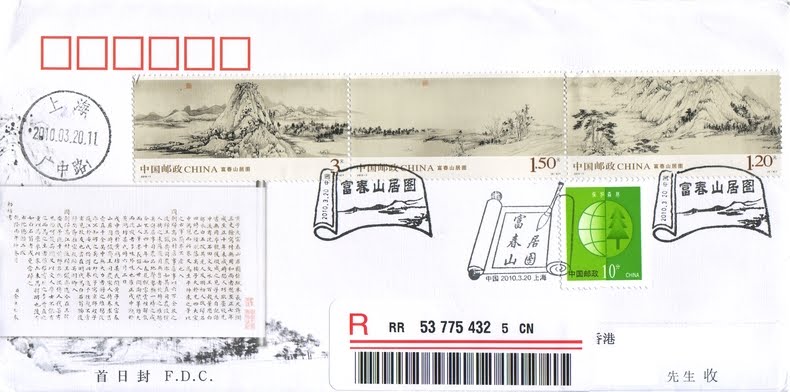 China
China Slovakia
 Aruba
Aruba
 Moldova
 Estonia
Date of Issue : 11 March 2010
The first world fair, The Great Exhibition of 1851, was held in Hyde Park London under the auspices of Prince Albert. The Crystal Palace, in which the whole world displayed its achievements, was built for the fair. Since 1928 Bureau International des Expositions (BIE), headquartered in Paris, coordinates holding of the fairs. By today 156 countries have acceded to BIE.
This year’s EXPO will take place from May 1 to October 31 in Shanghai in the People’s Republic of China. Estonia has so far taken part in ten world fairs. The stamp features the Estonian pavilion in Shanghai.
This is my first World Expo 2010 FDC outside China. Very nice !

 China
China  Estonia
Lesser Butterfly Orchid
Date of Issue : 19 February 2010
The lesser butterfly orchid (Platanthera bifolia) is one of the most common and also one the most favourite Estonian orchids. It can be found almost anywhere in the country but slightly more frequently in wetland meadows and sparse woods in Western Estonia. It has been given nearly one hundred popular names, of which ööviiul (night violin) is perhaps the most widespread. Apart from the cluster of its beautiful flowers it also has a two strong and prominent leaves united at the bottom that serve as a distinguishing feature from a related species, Platanthera chloranta. With the arrival of night the lesser butterfly orchid starts sending out a particularly strong scent that pervades the whole meadow or forest floor with it sweet and sometimes even rank odour. The smell attracts large numbers of insects to feed on the nectar in its long spur of up to three and half centimetres, but only butterflies with a long proboscis can really feast on it.
 China
China Sri Lanka
 Slovakia
 Cuba
Cuba
 Israel
 Finland


